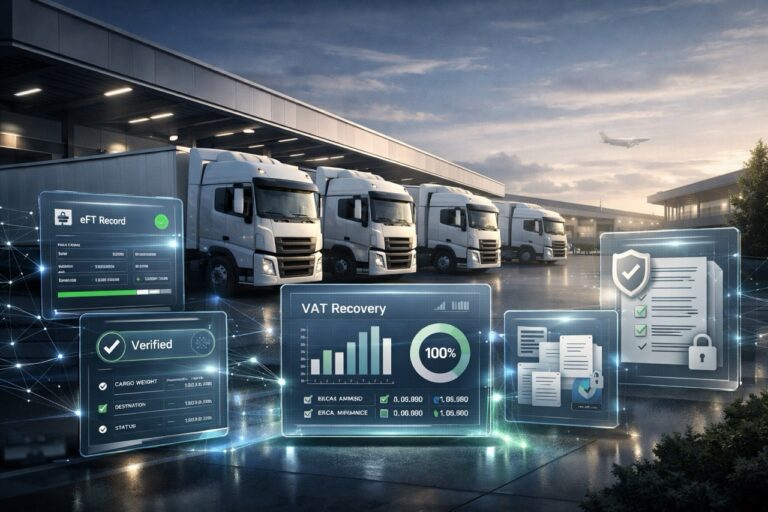
One Truth, Many Systems: Building a Unified Logistics Dashboard in a Fragmented Market
In the mid-2020s, “visibility” was the buzzword every logistics provider sold. But by 2026, the industry has realized a painful truth: Visibility without unification is just more noise. Most forwarders and shippers are currently operating in a “Data Graveyard.” They have one portal for ocean tracking, a different login for road telematics, an ERP (like Odoo or SAP) for billing, and a separate spreadsheet for CO2 reporting. When a customer asks, “Where is my cargo?”, the dispatcher has to manually stitch together a story from four different screens. This isn’t just slow, it’s a massive drain on your 2026 margins.
The Problem: The “Frankenstein” Tech Stack
The biggest bottleneck in 2026 logistics isn’t a lack of tech – it’s fragmentation.
The Integration Wall: Each mode of transport (air, sea, rail, road) runs on its own tech stack. They don’t speak the same language, meaning status updates like “Available for Pickup” mean different things in different portals.
- The “Stale Data” Trap: By the time you manually move data from your tracking tool into your TMS, the information is already 2 hours old. In a world of just-in-time manufacturing, 2 hours is the difference between a successful delivery and a €10,000 line-down penalty.
- The Search Term Reality: Logistics pros are increasingly searching for “how to consolidate logistics data” and “logistics data silo solutions” because they are tired of being “human APIs” who spend 50% of their day copy-pasting facts.
The Solution: The Swiss-Secure Unified Hub
At CargoBridge, we don’t believe in adding “another dashboard” to your screen. We believe in building the Universal Layer that pulls your fragmented systems into a single, AI-orchestrated source of truth.
1. Cross-Modal Data Normalization
Our AI acts as a universal translator. Whether the data comes from a Maersk EDI feed, a project44 API, or a driver’s eFTI update in the Baltics, CargoBridge normalizes it.
- The Result: Your dashboard shows one clean timeline. “Milestone: Arrived” means the same thing whether the cargo is on a ship, a train, or a truck.
2. The “Copy-Paste” Bridge to Legacy Systems
We know that many of your partners are still using “Stone Age” systems.
- The Feature: If a carrier sends you a status update in a messy email, you don’t have to manually update your ERP. You copy-paste the text into the CargoBridge intake.
- The Automation: The AI extracts the intent and automatically pushes that update to your unified dashboard and your connected ERP (Odoo/SAP/Oracle) simultaneously.
3. Military-Grade Privacy in the Swiss Vault
Unifying data often raises red flags about security. “If I pull all my billing, tracking, and carrier data into one place, is it safe?”
- Because CargoBridge is hosted in our “Swiss Vault”, your unified data is encrypted at the highest level.
- Unlike “Big Tech” visibility platforms that monetize your data to sell “market insights” back to you, our Open Core philosophy ensures your data stays your data. We are the neutral vault, not the data broker.
The ROI of Unified Clarity
Forwarders who have moved to a unified dashboard in 2026 are reporting:
- 70% Reduction in “Status Hunting”: Dispatchers no longer call carriers for updates – the data is already there, validated and synced.
- 15% Faster Decision Speed: When you can see your costs, ETAs, and carbon footprint on one screen, you can spot and solve bottlenecks before they cascade.
- Zero Manual Reconciliation: Billing and operational data are permanently linked, making end-of-month audits a “one-click” process.
One Family, One Version of the Truth
In the CargoBridge family, we believe that complexity shouldn’t be a burden. By unifying your fragmented systems into a single, AI-powered hub, we allow your team to stop being “detectives” and start being architects of a resilient supply chain.
Stop juggling portals. Build your unified future with the Switzerland of Logistics.