The 2029 eFTI Mandatory Roadmap: Why Starting in 2026 is a Competitive Advantage
While the buzz in the industry today is centered around the Q2 2026 certification window, the strategic thinker is already looking toward February 2029.
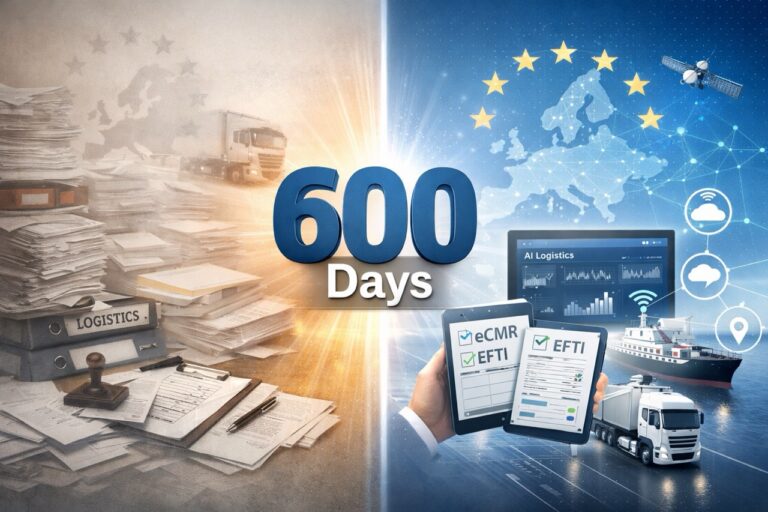
According to the official EU roadmap, 2029 is the year the European Commission will review the eFTI (Electronic Freight Transport Information) Regulation to decide on making digital submission mandatory for all economic operators. Currently, while authorities must accept digital data, companies still have the option to use paper.
However, waiting until 2029 to digitize isn’t “playing it safe”—it is a recipe for operational obsolescence. Here is why the “First Movers” of 2026 will dominate the logistics landscape of the next decade.
The Evolution of the Mandate: 2026 vs. 2029
The timeline is clear:
- January 2026: Certified platforms begin operations. Forwarders and carriers can start using eFTI-certified systems to prove compliance at the roadside and borders.
- July 2027: Full Application. Every EU Member State must have their “eFTI Gates” ready to accept digital data.
- 2029: The Review. This is the projected pivot point where the “right to use paper” will likely be phased out in favor of a 100% digital EU single market.
If you wait until the 2029 mandate to integrate your systems, you will be competing for IT resources and implementation support during a period of extreme “panic-buying.” By starting now, you have three years to refine your workflows, train your team, and, most importantly, capture the market share that legacy players will lose during their scramble to comply.
Three Ways Early Adoption Creates a 2026 Profit Center
1. The “Preferred Carrier” Status
Shippers are already under pressure to provide real-time visibility and ESG reporting. By 2027, they will prioritize carriers who can provide an eFTI Unique Identifying Link (UIL). If you are a carrier who can offer a paperless, “fast-lane” border experience, you become a strategic partner, not just a commodity provider.
2. Amortizing the “Digital Debt”
Transitioning from Excel and WhatsApp to an AI-driven, open-source platform takes time. Early adopters in 2026 can phase their implementation:
- Phase 1: Move document intake to AI to save on labor immediately.
- Phase 2: Integrate eFTI certification modules as they go live in Q2.
- Phase 3: Leverage the marketplace to eliminate empty miles. By 2029, your system will be a finely tuned profit machine, while your competitors are still trying to figure out how to map their data to the Common Data Set.
3. Data Sovereignty and the “Open Source” Edge
As the regulation tightens toward 2029, the security of your data becomes paramount. By choosing an Open Core (AGPL 3.0) platform today, you are building your business on a foundation that you control. You aren’t at the mercy of a proprietary vendor’s roadmap or price hikes. You are part of the “One Family” community, ensuring your technology evolves as fast as the EU laws do.
The Future belongs to the Interconnected
The eFTI mandate isn’t just about “replacing paper.” It’s about creating a Machine-to-Machine logistics network where data flows “automagically” from a shipper’s Odoo ERP, through a forwarder’s AI matching engine, directly to a carrier’s digital dashboard.
The savings, estimated at €1 billion annually for the EU sector, won’t be distributed equally. They will go to the companies that have the infrastructure to capture them.
Don’t wait for the 2029 mandate to force your hand. Start building your digital bridge today.